Home › Services
New and replacement septic systems for Boise and Treasure Valley properties
A septic system is the one part of a rural or edge-of-town property nobody swaps out over a weekend. Whether you are building on bare acreage in Ada or Canyon County or replacing a system that has simply run out of life, the job begins underground with the soil, moves through the regional health district, and finishes with a tank and an absorption area matched to the house. This page explains how a new system gets designed and approved around Boise, which system types show up most on Treasure Valley ground, how construction day really unfolds, and which line items belong on paper before you sign anything with an installer.
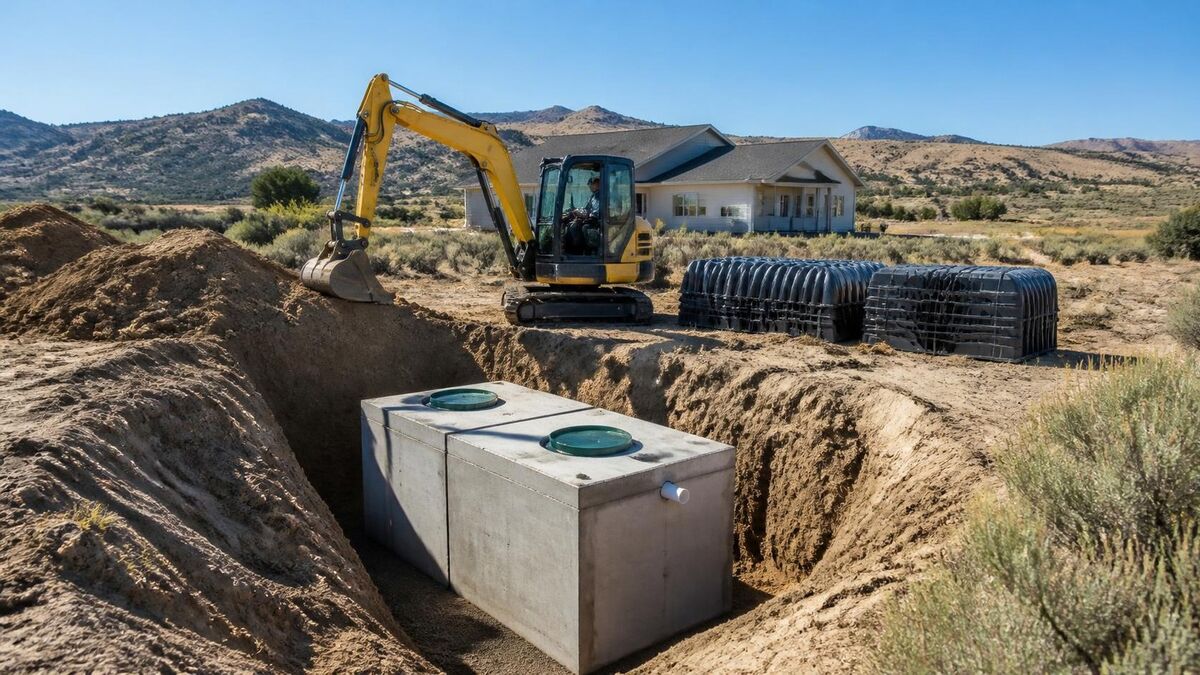
When a property needs a whole new system rather than a fix
The plainest case is a new house on land with no sewer main nearby, which describes much of the acreage and newer subdivisions spreading through outlying Ada and Canyon County. Another is a system whose absorption area has given out past the point of patching. A third is an addition: when a remodel adds bedrooms, the health district may look again at whether the existing tank and field still fit what the house could hold. Rusted steel tanks and unrecorded older systems also surface during sales.
If the trouble is one broken component instead of the whole system, the septic repair page covers fixes that stop well short of new construction.
Soil and site evaluation comes before any design is drawn
No design makes sense until someone has looked at the dirt. The usual method is a set of backhoe test holes where the absorption area is likely to go, dug well below planned trench depth so an evaluator can record each layer. Some evaluations still use a percolation test, timing how fast water drops in a prepared hole; others rely mostly on reading the soil profile. Which approach applies, and who may perform it, is the health district's call for that address. The evaluator is looking at:
- Texture: the mix of sand, silt and clay that governs how quickly water moves.
- Structure: whether the soil breaks into crumbs that pass water or sits in dense layers that do not.
- Mottling: rust and gray streaks that record how high water has risen in past seasons, even when the hole is dry today.
- Depth to a limiting layer such as caliche, cemented hardpan, fractured rock or the seasonal water table.
- Slope, surface drainage and any fill pushed onto the lot during earlier grading.
What Treasure Valley soil and water mean for a design
Along the Boise River and its old channels, sandy and gravelly layers can move water so fast that effluent gets little contact time before it drops below the root zone. Soil is supposed to treat the water, not just swallow it, so those sites often push a designer toward even dosing or extra treatment, especially where nitrate in groundwater is a concern.
Farther south and on some benches, caliche or hardpan can sit within a few feet of the surface, turning water sideways instead of down, so trenches stay shallow or the dispersal area gets raised. In irrigated country, groundwater climbs during irrigation season and falls in autumn; a winter test hole can look dry while the mottling on its walls tells a wetter summer story. Foothill lots add slope and thin soil over rock, and frozen ground limits when digging and inspections can practically happen.
How permitting runs through the health district
Septic permits here are handled by the regional public health districts under Idaho Department of Environmental Quality rules: Central District Health for Ada County, Southwest District Health for Canyon County. The district reviews the site evaluation, approves or returns the design, issues the permit and inspects the work before it is buried. Fees, forms, timelines and the rules for a given lot all come from the district. The broad sequence looks like this:
- An application goes in with a site plan showing the house, wells, property lines, driveways and the proposed system location.
- The site evaluation is completed and the soil findings are reviewed.
- A design is prepared for that soil and house, by the installer or by an engineer or designer when the site calls for one.
- The district issues a permit or asks for changes.
- The system is built to the approved design and inspected before backfill, then receives final approval.
Tank sizing follows bedroom count, not today's household
A couple living alone in a four-bedroom house still needs a system sized for four bedrooms, because bedrooms stand in for how many people the home could hold over its life. The health district sets the minimum tank capacity and absorption area tied to that count and may weigh garbage disposals, oversized tubs or a home business. Ask the district or designer for the figure that applies rather than copying a neighbor's system.
Tanks come in precast concrete, polyethylene and fiberglass. Concrete resists floating when groundwater rises but needs a truck with reach to set it; lighter tanks suit tight lots but must be bedded or anchored where high water could lift them. Many designs use two compartments plus an outlet effluent filter. Specifying risers to grade now saves digging later, as the septic tank pumping page explains.
Conventional gravity systems and the chambers or gravel decision
Where soil is decent and the absorption area sits downhill from the house, a gravity layout is the simplest choice: effluent leaves the tank and flows through solid pipe to a distribution box that splits it among trenches. Inside the trenches, the older method lays perforated pipe in washed rock under a fabric barrier; the newer one uses molded plastic chambers, open-bottomed arches that leave a hollow space over the soil.
- Rock trenches are long proven but depend on clean stone; rock carrying fines can clog the soil surface early.
- Hauling rock adds truck trips and weight on a soft or finished lot.
- Chambers are light, quick to place by hand and expose more open soil to the effluent.
- Some districts adjust required trench length for chambers, so footprints can differ under local rules.
- Either method succeeds or fails on soil, depth and installation care, not product brand.
Pump-to-field and pressure distribution for harder sites
If the best soil sits uphill or far across the lot, or trenches must stay shallow over hardpan, a pump enters the design. A dosing tank follows the septic tank, floats switch the pump on when enough effluent collects, and a high-water alarm warns the household if something stops.
Pressure distribution, often called a low-pressure pipe system, goes further: small laterals with drilled holes run through the field, and each cycle spreads a measured dose across all of them. Instead of one trench end getting soaked while the far end stays dry, the whole area shares the load, which helps fast sandy soils treat water and lets shallow sites use every usable foot. The price is more parts to wear: pump, controls, a circuit, an alarm and laterals that need periodic flushing.
Advanced treatment and alternative designs where soil falls short
Some lots lack enough good soil above groundwater or hardpan for a standard design. Advanced treatment units pump air into a chamber so oxygen-loving bacteria break down far more of the load, and the cleaner effluent can go to a smaller or shallower dispersal area. Sand filters, raised beds of imported fill and drip lines are other options.
These come with obligations. Blowers and pumps draw power and need parts, and alarms must be answered. Many permits for advanced designs carry ongoing service conditions that pass to the next owner. Ask what those are, who may service the unit, and what happens during a power outage before you choose one.
Setbacks, wells and where the system can physically fit
Every system must keep its distance from wells, including the neighbor's, property lines, foundations, surface water, irrigation canals and ditches, and steep cuts. The distances are set by the regulations and measured by the designer on the site plan, not estimated from memory. On a small lot with its own well and a ditch along the back, they can decide where the house goes, so settle well and septic locations together before the foundation is staked. Many lots must also hold a replacement area kept clear for the day the first field wears out; driveways, shops and paddocks belong off both.
The construction sequence, from staking to final cover
The build follows a predictable order. Wet or frozen ground is a real reason to wait, because working soggy soil smears trench walls and seals them.
- Utilities are marked through 811, the free call-before-you-dig service, and the owner flags private wells and irrigation lines.
- Tank, distribution parts and trenches are staked to match the approved design.
- The tank hole gets a level, compacted base so the tank will not settle unevenly.
- The tank is set and the house sewer connected with steady fall and a cleanout.
- Trenches or beds are dug to specified depth with level bottoms and rough, unsmeared walls; pumps, alarms and wiring go in where needed.
- The district inspects the open system, then it is backfilled, risers brought to grade, the surface shaped to shed water and seeded.
- An as-built drawing is filed, and the old tank on a replacement job is pumped and abandoned the way the district requires.
What a complete installation proposal should spell out
The contractor prices the job after seeing the site and the approved design. The main cost drivers are soil, the system type the site demands, tank size and material, excavation depth and length, rock or caliche, truck access, imported fill, electrical work, permit and design requirements, and restoration. If the old field failed early, read the drain field repair page first so the same causes do not shorten the new one. A complete proposal names:
- System type, the permit it is built to, and absorption area size and layout.
- Tank material, capacity, compartments, filter and riser details.
- Pump, panel, alarm and electrical scope, and who runs power to it.
- Who handles the application, design and inspections, and which fees fall to the owner.
- Old tank abandonment, spoil and debris handling, and restoration of grade, lawn and irrigation lines.
- Exclusions such as dewatering or unexpected rock, how changes are priced, and written workmanship coverage terms.
Getting a new system started for your property
Projects show up across the valley, from acreage south of Kuna to west-side subdivisions around Star; the service areas page lists the communities covered. When you are ready, send the address and a few photos along with the bedroom count and any permit or evaluation paperwork, and we will connect you with a septic contractor working the region.
New Septic Systems: questions people ask
What is the typical wait for Central District Health to approve a septic permit in Ada County?
No single answer fits, because timing depends on how busy Central District Health is, whether the soil evaluation is straightforward, and whether the design needs revisions. A gravity system on good soil usually moves faster than an advanced design on a tight lot near wells, and spring building season fills everyone's calendar. Ask the district for current review times and leave slack in the construction schedule.
Can I install my own septic system in Idaho?
Whether an owner may install their own system is set by the health district and state rules, and it can depend on system type. Where it is allowed, the same permit, approved design and pre-backfill inspection still apply, and the work must match the design exactly. Most people underestimate the equipment and grading accuracy involved. Ask Central District Health or Southwest District Health what they permit for your parcel.
Are plastic septic tanks as good as concrete tanks?
Both serve well when installed correctly and accepted for the design. Concrete is heavy and rigid and naturally resists being lifted by groundwater, but needs large equipment to set. Polyethylene and fiberglass are far lighter, which helps on remote or crowded lots, yet they rely on careful bedding, backfill and sometimes anchoring. On irrigated ground with a high summer water table, ask exactly how the tank will be kept from floating.
What happens if my lot fails the soil evaluation?
A poor result usually narrows the options rather than ending them. The district may still approve pressure distribution, a sand filter, a raised bed or an advanced treatment unit. Testing a different part of the lot sometimes finds better soil, or the house footprint shifts to free up room. A few parcels truly cannot support a system. Ask the evaluator what the limiting layer was and which designs the district would consider.
Can I put a driveway or shop over my septic system?
It is a bad idea. Vehicles and heavy equipment compact soil and can crack tanks, lids and pipes, and structures block access for service and replacement. Setback rules also keep buildings away from tanks and absorption areas, and many lots have a reserved replacement area that must stay open. Before planning a shop or parking pad, pull out the as-built drawing and mark both the active system and the reserve on the ground.
How do I know what size septic system my new house needs?
The health district sets minimum tank capacity and absorption area, tied mainly to bedroom count. Soil type then decides how large the absorption area must be, since slower soils need more surface for the same flow. A garbage disposal, home business or guest suite can raise the requirement. Your designer or installer should show the sizing basis in writing, and the district can confirm it against your plans.
Does a brand-new septic system need any maintenance?
Yes, starting with paperwork: keep the permit, as-built drawing and any pump or treatment unit manuals where the next owner can find them. Have the tank checked on a schedule based on measured sludge, and clean the effluent filter when due. Systems with pumps or blowers need alarms tested and controls kept dry. Keep vehicles, livestock and aggressive-rooted plantings off the field from the first season.
Talk through your site
Start with the address, what you want done, and a few photographs of the area, including anywhere water sits after a heavy rain.
Related work
Septic Tank Pumping
Pumping on a sensible schedule, what should be checked while the lid is open, and how often is too often.
Septic Inspections
Inspections for home sales and refinances: what a real inspection covers and where it stops.
Septic Repair
Baffles, lids, risers, pipes, pumps and alarms: failures that can be fixed without a whole new system.
Drain Field Repair
Soggy ground, slow drains and odors from a struggling field, and the options from rest to replacement.
Across the metro
Kuna
Fast-growing south-valley acreage and subdivisions, many on septic, on caliche and shallow hardpan.
Nampa
Canyon County homes on irrigated ground with seasonal high groundwater and older rural systems.
Eagle
Foothill and river-bottom lots, larger homes and systems sized for big households.
Star
Newer west-valley subdivisions and acreage where septic is the norm and irrigation season matters.